All posts




All posts
Prior Authorization
Provider
March 9, 2026
Prior authorization is one of the most operationally complex, financially consequential, and clinically disruptive processes in healthcare. And yet, for most health systems, the technology meant to manage it was never actually built for it.
The result is a familiar pattern: manual workarounds that outlive every implementation, staff burnout that compounds with volume, denial rates that stubbornly resist improvement, and patients whose care is delayed not by clinical judgment but by administrative friction.
The market for prior authorization solutions has grown significantly in recent years, but growth has brought noise. Point solutions that automate one step while leaving others untouched, RCM platforms that bolt on PA as a feature rather than a focus, and AI-powered promises that dissolve on contact with real-world clinical data environments. For a VP of Revenue Cycle, a CFO, or a Director of Patient Access evaluating solutions today, the challenge isn't finding options, but how to tell them apart.
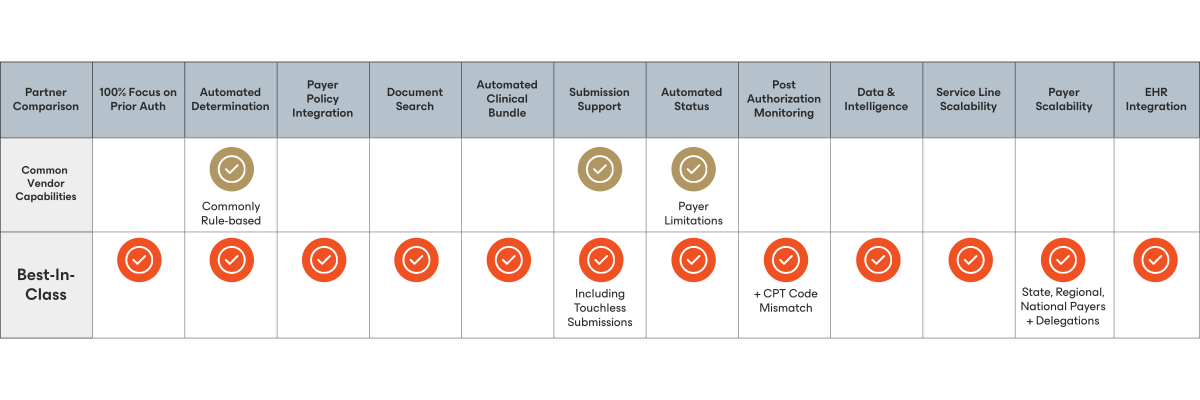
This guide exists to solve that problem.
What follows is a framework built around 12 dimensions that separate best-in-class prior authorization solutions from everything else. These dimensions were developed from the ground up to reflect how PA actually works and to give revenue cycle leaders a rigorous, repeatable way to evaluate the solutions they encounter.
The 12 dimensions are organized across three foundational categories that reflect the true nature of the prior authorization problem. PA is not purely a technology problem, though technology is essential. It is not purely an interoperability problem, though connectivity determines what's possible. And it is not purely an intelligence problem, though intelligence is what separates automation from transformation. It is all three, and a solution that excels in only one or two will always leave performance on the table.
.svg)
Together, these three categories define what a prior authorization solution actually needs to be. The 12 dimensions that follow show you how to evaluate whether any solution you're considering truly delivers on all three.

Most prior authorization solutions in the market today were not designed with PA as their primary focus. They emerged from broader revenue cycle management platforms, practice management systems, or clearinghouse infrastructure, and PA was added over time as a module, an acquisition, or a response to market demand.
Why It Matters: When PA is a feature within a larger platform, product development priorities are divided. Roadmap decisions reflect the needs of the broader product, integrations are built to serve the solution’s architecture rather than the nuances of payer connectivity, and response time to new requirements reflects where PA sits in the vendor's overall priority stack. That gap compounds over time, and health systems feel it in denial rates, implementation delays, and support responsiveness.
What Good Looks Like: A purpose-built solution is one where every capability and every engineering decision exists to solve the prior authorization problem specifically. The vendor's payer relationships, EHR integrations, and clinical intelligence capabilities are deeper because those relationships are the entire business. Product development moves faster because there are no competing priorities. And when regulatory requirements change (as they increasingly do), response time is measured in weeks, not quarters. A vendor's willingness to connect you with referenceable customers– health systems of similar size, specialty mix, and EHR environment– is itself a signal of confidence in their outcomes.
Purpose-built extends beyond the product itself. The vendor's entire organization should reflect the same focus: implementation specialists who understand PA workflows rather than generic onboarding teams, workflow analysts who know how authorization processes vary across specialties and care settings, and a customer success function that is fully dedicated to prior authorization outcomes. When the people supporting your implementation and ongoing performance understand PA as deeply as the technology does, the gap between go-live and optimized performance closes significantly faster.
Questions to Ask Vendors:
The word "automation" appears in nearly every prior authorization vendor's marketing materials. But automation is not a binary, and the distance between a solution that automates one step in the PA workflow and one that eliminates manual work across the entire process is where most of the performance gap between solutions actually lives.
Why It Matters: PA volume is not slowing down. According to the 2024 AMA Prior Authorization Physician Survey, clinicians and their staff complete an average of 39 PAs per physician per week, spending approximately 13 hours on the process, and 40% of practices have hired staff who work exclusively on PA. A solution that automates submission but leaves requirements checking, clinical bundling, status tracking, and post-approval monitoring as manual tasks has not solved the problem. The operational relief health systems need comes from exception-based workflows, where staff only touch the cases that genuinely require human judgment.
What Good Looks Like: A best-in-class solution automates the full scope of the PA workflow: requirements determination through submission, statusing, and post-approval monitoring. It creates an exception-based environment where routine cases move without human intervention, and staff attention is reserved for complex or escalated work. The result is measurable: fewer touches per case, faster turnaround, and a meaningful reduction in FTE workload without sacrificing accuracy. Look for solutions that can demonstrate auto-closure rates, touches per case, and efficiency gains across the full workflow.
Questions to Ask Vendors:
.svg)

Submitting a prior authorization is straightforward, in theory. Submitting one that gets approved the first time is not. The difference almost always comes down to clinical documentation– whether the right information was gathered, whether it aligned with the specific payer's criteria, and whether gaps were identified before submission.
Why It Matters: Most denials are not random. They follow a predictable pattern: documentation that doesn't match payer-specific criteria, missing attestation responses, or clinical bundles assembled by staff who are guessing at what each payer actually requires. According to the 2024 AMA Prior Authorization Physician Survey, 93% of physicians report that PA delays access to necessary care, and incomplete or misaligned documentation is one of the most consistent drivers of those delays. The downstream cost shows up in peer-to-peer rates, reschedules, write-offs, and staff time spent on rework.
A solution with genuine clinical intelligence doesn't wait for a denial to reveal a documentation gap. It identifies what each payer requires, retrieves the right clinical evidence from the medical record, and surfaces gaps before submission– so the first submission is the right one.
What Good Looks Like: Clinical intelligence in a best-in-class PA solution operates across several layers. At the policy layer, the solution retrieves and structures payer-specific criteria automatically, refreshing daily so staff are always working from current requirements rather than outdated guidelines. At the documentation layer, NLP and OCR-based classification intelligently curates clinical bundles tailored to the specific payer and procedure, drawing from the full medical record rather than relying on staff to manually identify and attach relevant documents. At the attestation layer, the solution auto-answers payer questionnaires by mining the clinical record for required evidence and citing source documentation directly.
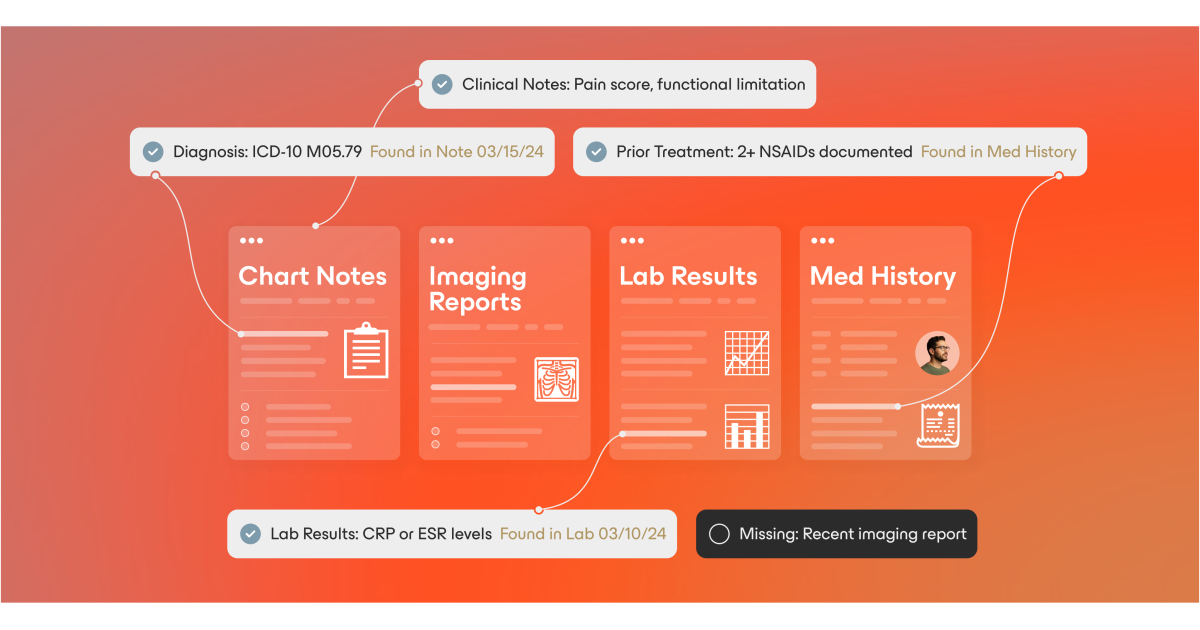
Critically, a mature clinical intelligence capability also handles real-world data environments. Health system EHRs contain unstructured, inconsistent, and incomplete documentation. A solution that requires clean, structured data inputs before it can function will struggle in production– the best solutions are engineered to work with clinical data as it actually exists, not as it ideally should.
Questions to Ask Vendors:
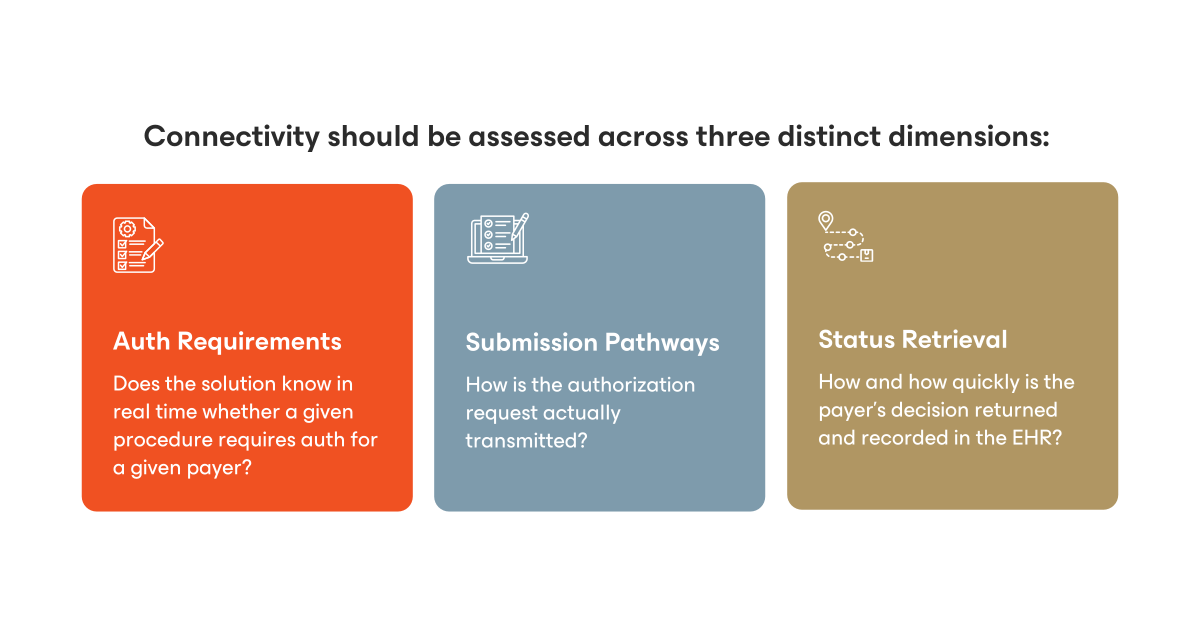
Prior authorization doesn't happen in a vacuum, it happens across a sprawling, fragmented payer landscape that includes national commercial insurers, regional health plans, Medicare and Medicaid programs, and a complex web of delegated review entities that manage authorization decisions on behalf of payers for specific services and specialties. A solution's ability to connect to that landscape broadly and deeply is one of the most direct determinants of how much automation is actually achievable in practice.
Why It Matters The relationship between payer connectivity and automation is straightforward: the more connected a solution is, the more of the PA workflow it can automate, and the more value it delivers. A solution with limited payer connectivity can still provide workflow tools and clinical intelligence capabilities (like clinical bundling and post-approval monitoring) independently of payer connections, but the ceiling on automation is determined by the depth and breadth of payer relationships the solution can draw on.
The nature of the payer landscape makes this genuinely complex. Health systems don't just work with a handful of national payers. They work across state and regional plans, Medicare Advantage organizations, Medicaid managed care entities, and delegated review organizations that sit between payers and providers on a significant volume of high-value authorizations. A solution without deep connectivity across that full spectrum will leave meaningful automation gaps precisely where authorization volume and complexity are highest.
Connectivity architecture also determines how quickly authorization status is retrieved, how reliably EHR systems are updated, and whether staff are chasing payers manually or working from real-time data.
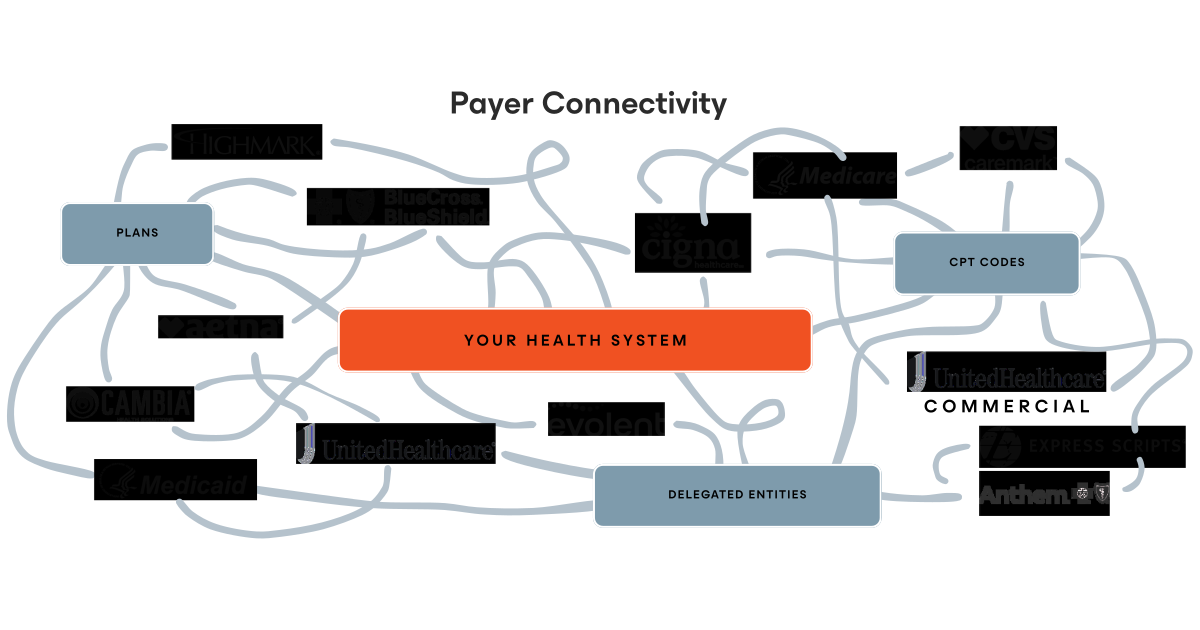
What Good Looks Like A best-in-class solution pursues the deepest available connection to every payer it works with– direct API integration where available, and portal automation where APIs are not yet accessible– with a clear roadmap for expanding direct connectivity over time. The goal is maximum automation across the full payer mix, not a single connectivity approach applied uniformly regardless of what each payer supports.
Questions to Ask Vendors:
One of the most persistent frustrations in prior authorization is that providers are often making decisions about documentation, order timing, and clinical approach without clear visibility into what payers actually require. Policy criteria are buried in dense documents across hundreds of payer portals, updated without notice, and interpreted inconsistently across staff. The result is a workflow built on guesswork, and denial rates reflect it.
Why It Matters: Policy transparency is not just a convenience but a foundational requirement for consistent first-pass approval. When staff don't know exactly what a payer requires for a given procedure or drug, they default to what worked last time, what a colleague suggested, or what they could find after twenty minutes of portal navigation. None of those approaches scale, and none of them keep pace with the frequency at which payers update their criteria.
According to the 2024 AMA Prior Authorization Physician Survey, 31% of physicians report that PA criteria are rarely or never evidence-based, a finding that reflects not just payer behavior but the opacity of the criteria themselves. When providers can't see the policy, they can't align to it. And when they can't align to it, denials follow.
What Good Looks Like: A best-in-class solution brings payer policy out of the portal and into the workflow. This means automatically retrieving plan-and-specialty specific policy criteria via API, structuring that information into actionable requirements, and refreshing it daily so staff are always working from current guidelines. It also means going beyond retrieval– deconstructing lengthy, complex policy documents into discrete criteria sets that can be directly matched against clinical documentation before submission.
For drug authorizations specifically, where policy complexity includes step therapy requirements,, diagnosis criteria, and quantity limits, this capability becomes even more critical. A solution that can surface exactly what a payer requires for a specific drug, plan, and patient profile, identifying documentation gaps in real time before submission, is operating at a fundamentally different level than one that simply links to a payer's policy page.
This is also where the distinction between static policy libraries and dynamic, real-time policy intelligence matters most. A library tells you what the policy said when it was last updated. Dynamic intelligence tells you what it says today.
Questions to Ask Any Vendor
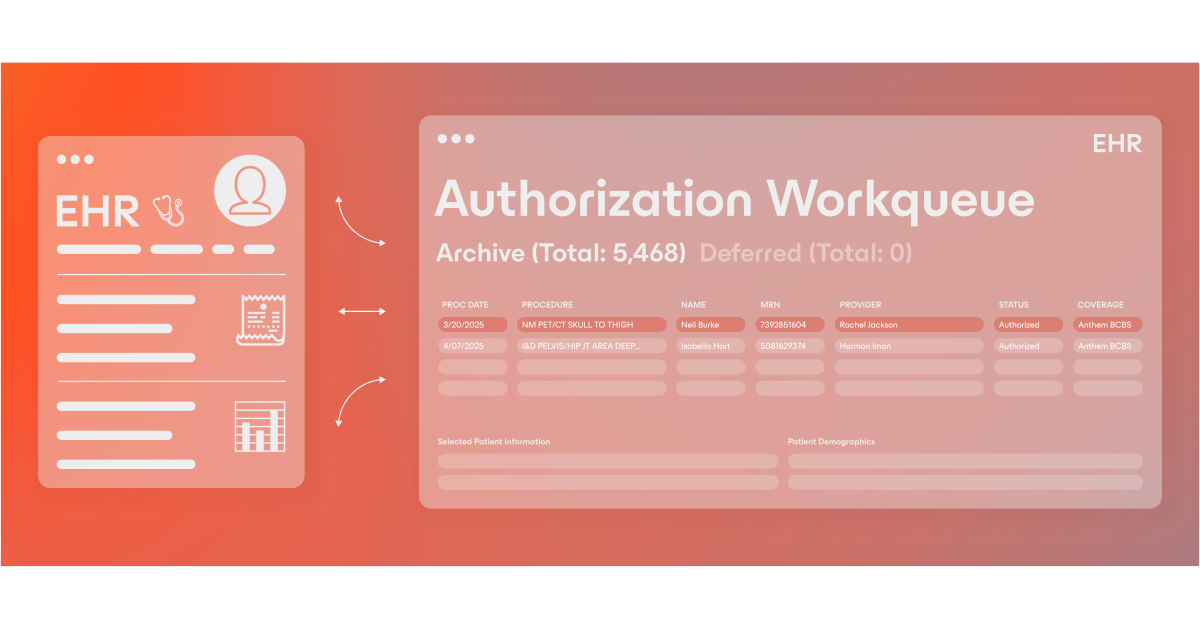
Electronic health record integration is another capability that vendors describe in broadly similar terms but deliver in meaningfully different ways. "Integrated with Epic" can mean anything from a deep, native workflow experience to a hyperlink that opens an external application in a separate browser tab. For the staff who live in EHR systems all day, that distinction is the difference between a solution they actually use and one they work around.
Why It Matters: Workflow disruption is a consistently underestimated barrier to PA automation adoption. When a solution requires staff to leave the EHR, log into a separate system, re-enter patient and order information, and then manually reconcile outcomes back into the chart, the efficiency gains of automation are largely offset by the friction of context switching. Staff revert to familiar workarounds, adoption stalls, and the health system is left with a solution it paid for but doesn't fully use.
The problem compounds at scale. For health systems managing high authorization volumes across multiple departments and facilities, an integration model that requires parallel workflows creates inconsistency, increases error rates, and makes standardization across sites nearly impossible.
What Good Looks Like: Best-in-class EHR integration means staff never have to leave their primary workflow to manage prior authorization. The solution embeds natively within the EHR, surfacing authorization requirements, clinical documentation, submission status, and payer decisions directly within the interfaces staff already use. Bi-directional data flow ensures that information moves seamlessly between the PA solution and the EHR without manual reconciliation, and that authorization outcomes are written back to the patient record automatically.
EHR platforms evolve continuously, and vendors need to evolve with them. In Epic environments, for example, eMPA has replaced legacy RTA as the standard for prior authorization workflow integration. Vendors that keep pace with the latest EHR architecture deliver deeper access to clinical data, more reliable performance, and a better staff experience. Those that don't introduce unnecessary friction and leave value on the table.
Questions to Ask Vendors:
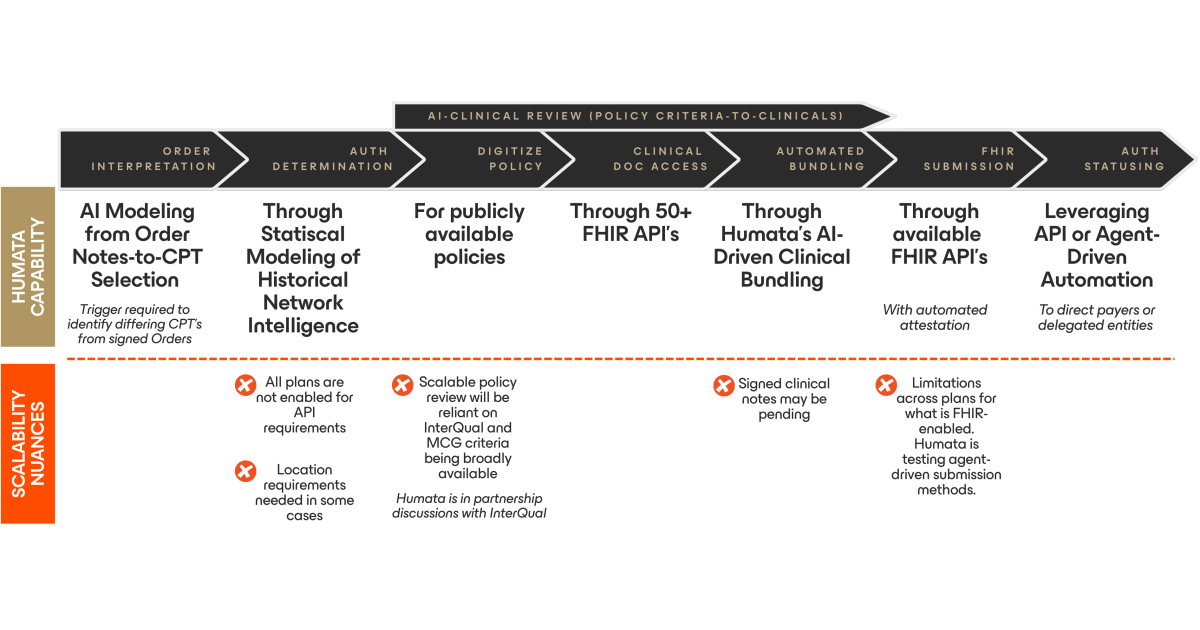
The prior authorization workflow has traditionally started too late. An order is placed, a PA requirement is identified, and the authorization process begins, often hours or days after the clinical decision has already been made. The opportunity to influence documentation, adjust the order, or flag a potential issue has passed. The industry is actively working to change that, and the vendors investing in point-of-care authorization intelligence today will define what best-in-class looks like tomorrow.
Why It Matters: The cost of reactive PA management shows up in predictable places: orders that require revision after submission, documentation gaps identified only after a denial, and scheduling decisions made without visibility into how long a specific payer will take to respond. Each of these is a downstream consequence of a workflow that starts too late in the clinical process.
As PA volumes grow and payer criteria become more complex, the gap between reactive and proactive authorization management becomes a meaningful performance differentiator. Health systems that can identify authorization requirements, surface documentation gaps, and flag potential issues at the moment of ordering (rather than after) will consistently outperform those that cannot on first-pass approval rates, days-out, and reschedule rates.
The technology to do this is still maturing, and there are real industry-level constraints around EHR workflow design, payer API availability, and ambient platform adoption that limit how far point-of-care intelligence can reach today. That makes vendor roadmap and partnership strategy as important as current capability when evaluating this dimension.
What Good Looks Like: Proactive authorization intelligence operates at two levels. At the point of care, the solution detects CPT codes as they are being ordered, confirms authorization requirements in real time, and surfaces any documentation gaps while the patient is still present and the clinical record is most actionable. Partnerships with ambient AI platforms (Microsoft Dragon Copilot, for example) represent the frontier of this capability, enabling authorization checks and documentation nudges to happen naturally within the clinical encounter rather than as a separate administrative step afterward. These integrations are actively being developed and deployed, and a vendor's progress and partnerships in this space signal their commitment to moving authorization intelligence earlier in the clinical workflow.
At the operational level, proactive intelligence extends to scheduling. Knowing how long specific payers typically take to decide on specific procedure types and surfacing that data during the scheduling process allows care teams to build realistic timelines, reduce reschedules, and set accurate patient expectations before authorization delays become care delays.
A solution should also handle CPT code changes proactively. When codes are modified at the order level or identified post-procedure through operative notes, the solution should flag those changes in real time and assess their impact on existing authorizations before a claim is submitted against an invalidated approval.
Questions to Ask Vendors:
Prior authorization doesn't look the same across every service line. A radiology authorization involves different documentation requirements, payer rules, and submission pathways than an oncology infusion authorization or a specialty pharmacy request. A solution that performs well in one clinical context but struggles in another creates uneven outcomes across the organization and forces health systems to manage multiple vendors, workflows, and integrations to cover their full authorization footprint.
Why It Matters: For health systems evaluating PA solutions, specialty coverage is often assessed at the surface level: a vendor confirms they support radiology, cardiology, and orthopedics, and the conversation moves on. But the more important question is depth, not breadth. Can the solution handle the documentation complexity of a high-volume surgical case the same way it handles a straightforward imaging authorization? Can it manage the policy intricacy of a specialty drug authorization– including step therapy requirements and diagnosis-specific criteria– within the same workflow as a procedure auth?
The medical versus pharmacy benefit question adds another layer of complexity. Many health systems manage authorizations across both benefit types, and the fragmentation that results from using separate solutions for medical and pharmacy benefit authorizations– different workflows, different data environments, different submission pathways– creates rework, delays, and visibility gaps that compound at scale.
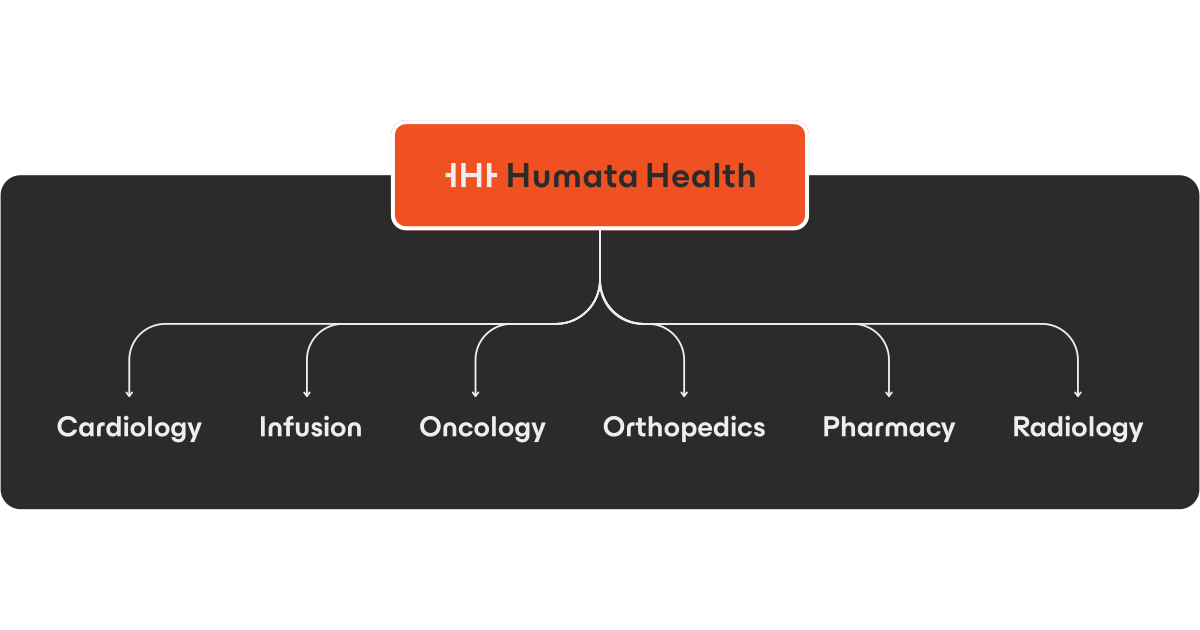
What Good Looks Like: A best-in-class solution handles the full scope of authorization types a health system encounters within a single, unified workflow. That means consistent performance across high-volume specialties like radiology, cardiology, orthopedics, pain management, and surgery, as well as complex drug authorizations spanning medical and pharmacy benefits: infusions, specialty Rx, and PBM-routed requests included. The underlying infrastructure (EHR integration, payer connectivity, clinical intelligence, policy capabilities) should function consistently regardless of the specialty or benefit type, without requiring parallel workflows for different service lines.
Scalability also means performance under volume. A solution that works well at moderate authorization volumes but degrades under the load of a large health system's full authorization footprint is not truly scalable. Look for evidence of consistent performance across high-volume environments and across geographically distributed facilities with different specialty mixes.
Questions to Ask Vendors:
Most prior authorization conversations focus on getting to a decision. Far fewer focus on what happens after. But for health systems managing high authorization volumes across complex payer mixes, the period between approval and claim submission is where a significant and often underestimated amount of revenue is lost.
Why It Matters: An approved authorization is not a guarantee of payment. CPT codes change between authorization and procedure, scheduled dates shift, sites of service are modified. Any of these changes can invalidate an existing authorization, and if that invalidation isn't caught before the claim is submitted, the result is a denied claim on a service that was already approved. The write-off that follows isn't a denial in the traditional sense. It doesn't show up in first-pass approval metrics. It doesn't trigger a peer-to-peer. It simply disappears from revenue that should have been captured.
It's also worth noting that no authorization required (NAR) does not equal guaranteed payment. Even when a prior authorization is not required for a given service, documentation still needs to align with coverage criteria, including NCD and LCD requirements for Medicare. A best-in-class solution supports medical necessity review even in NAR scenarios, ensuring that the absence of a PA requirement doesn't create a blind spot in revenue integrity.
For specialty drug and infusion authorizations, the stakes are even higher. Recoupments represent a category of revenue risk that compounds quietly over time and is often invisible until it surfaces in an audit.
What Good Looks Like: A best-in-class solution doesn't stop working at approval. Continuous monitoring tracks cases consistently, flagging changes in CPT codes, service dates, and sites of service in real time and automatically pulling back cases that require review before a claim is submitted against an invalidated approval. Staff are notified immediately, with enough lead time to act– not after the fact when the window to recover has closed.
For drug authorizations, pre-submission policy alignment– checking documentation against current payer criteria before the authorization is submitted– prevents the documentation gaps that drive recoupments downstream. The solution should be able to identify those gaps in real time, during the authorization workflow, when they can still be addressed.
The combined effect is measurable. Health systems with mature revenue protection capabilities consistently see meaningful reductions in write-offs, fewer post-approval denials, and greater scheduling confidence, because the team knows that an approved authorization will hold through to the claim.
Questions to Ask Vendors
Data is not the same as insight. Most prior authorization solutions produce reporting of some kind: case volumes, approval rates, turnaround times. But for revenue cycle leaders trying to identify where performance is breaking down, which payers are driving the most friction, and where staff capacity is being consumed, aggregate reporting rarely tells the full story. The difference between basic dashboarding and genuine operational intelligence is the difference between knowing something happened and knowing what to do about it (and why).
Why It Matters: Prior authorization performance is rarely uniform across an organization. Denial rates vary by payer, by service line, by procedure type, and by individual provider. Peer-to-peer rates spike in specific clinical contexts. Days-out fluctuate in ways that affect both revenue cycle performance and patient access. Without visibility into those patterns at a granular level, improvement efforts are directionally correct at best and completely misdirected at worst.
The operational cost of poor PA visibility extends beyond reporting. When scheduling teams don't have access to payer-specific days-to-decision data, they schedule based on assumptions rather than evidence, creating downstream reschedules when authorizations arrive later than expected. When leadership can't track peer-to-peer rates by provider, they can't identify documentation gaps that are driving unnecessary clinical escalations. The data exists within the PA workflow. The question is whether the solution surfaces it in a way that drives action.
What Good Looks Like: A best-in-class solution provides two distinct tiers of analytics that together drive continuous improvement. The first is technology performance analytics: automation rates at the feature level that tell you how effectively the solution itself is performing. Are cases being auto-closed at expected rates? Where in the workflow are manual touches still occurring? This tier answers the question: is the technology doing its job?
The second tier is clinical and operational insight analytics: the more nuanced layer that tells you what is or isn't driving first-pass approval. Is bundling quality the issue, or is it documentation gaps at the provider level? Are specific payers denying erroneously, or are submissions genuinely misaligned to policy? Are patients being scheduled too soon, before authorization windows have closed? Are data changes occurring unnecessarily and triggering avoidable denials? This tier answers the question: where is the process breaking down, and what needs to change?
Together, these two tiers transform analytics from a reporting function into a continuous improvement engine— one that gets smarter over time as patterns emerge across payers, providers, service lines, and procedures.
Questions to Ask Vendor:
The regulatory environment around prior authorization is changing faster than at any point in the program's history. Federal rules, state legislation, and payer-driven initiatives are collectively reshaping what health systems, payers, and technology vendors are required to do, and on increasingly compressed timelines. For organizations evaluating PA solutions today, a vendor's ability to stay ahead of that regulatory curve is a core capability.
Why It Matters CMS-0057-F, finalized in early 2024, established new requirements for payer interoperability and prior authorization transparency, including mandates for FHIR-based API connectivity, decision timeframes, and denial reason transparency that will reshape how authorizations are submitted, tracked, and documented across Medicare Advantage, Medicaid, and CHIP plans. The Da Vinci Project, a HL7 FHIR accelerator initiative, has established the technical standards, including the Coverage Requirements Discovery and Prior Authorization Support implementation guides, that are increasingly becoming the baseline expectation for compliant PA data exchange.
For health systems, the implications are actively unfolding.
As payers begin evolving their approach to interoperability, providers need to stay engaged on what that means operationally: how EHR workflows will change, how APIs will be adopted across the payer landscape, how vendor technologies will need to evolve, and critically, where gaps will still exist even as standards advance. Choosing a solution that is built on modern infrastructure and actively participates in that evolution is the difference between staying ahead of regulatory change and scrambling to catch up with it.
State-level legislation adds further complexity. Prior authorization reform bills have been introduced or passed in a growing number of states, with varying requirements around decision timeframes, gold-carding programs, and clinical criteria transparency. A solution that is genuinely regulatory-ready tracks and responds to those changes proactively, not reactively.
What Good Looks Like: A best-in-class solution is built on modern, standards-compliant infrastructure from the ground up. FHIR-native data exchange, Da Vinci implementation guide support, and CMS-0057 activation are architectural characteristics, not compliance patches applied after the fact. The solution should have a clear, documented approach to regulatory monitoring, actively tracking federal and state developments and translating them into product updates on timelines that give health system customers adequate lead time to adapt.
Participation in regulatory pilots and working groups is a meaningful signal. Vendors selected for CMS initiatives, such as the WISeR program for Medicare coverage criteria review, demonstrate both technical credibility and a proactive posture toward the regulatory environment that distinguishes them from vendors who wait for mandates before acting.
Questions to Ask Any Vendor
Selecting a prior authorization solution is not a transactional decision. It is a long-term operational commitment that touches protected health information, clinical workflows, revenue integrity, and increasingly, the governance frameworks that health system boards and compliance teams are being asked to maintain around AI-powered technology. The question of whether a vendor can be trusted with data, with AI, and as a long-term partner deserves the same rigor as any other dimension in this evaluation.
Why It Matters: Healthcare data security requirements are not static. As prior authorization solutions handle more sensitive clinical and financial data across broader EHR and payer integrations, the security posture of the vendor becomes a direct extension of the health system's own risk profile. A breach, a compliance gap, or an AI decision that can't be explained or audited doesn't stay contained to the vendor; it becomes the health system's problem.
At the same time, AI governance is emerging as a formal organizational requirement at many health systems. Boards and compliance teams are establishing AI governance frameworks that require vendors to demonstrate how their models are tested for bias, how decisions are documented and explainable, and how human oversight is maintained within automated workflows. For PA solutions specifically, where AI-driven decisions influence clinical access and revenue outcomes, the ability to satisfy those governance requirements is becoming a procurement prerequisite rather than a nice-to-have.
What Good Looks Like: From a security standpoint, best-in-class solutions maintain SOC 2 Type II reports and HITRUST r2 certification, with the latter being widely recognized as the most comprehensive security framework specific to healthcare data environments. HIPAA compliance is a baseline expectation; HITRUST r2 certification demonstrates that compliance has been independently validated against a rigorous, healthcare-specific control framework.
On AI governance, a trustworthy solution is designed with human oversight as a structural feature, not an afterthought. Exception-based workflows ensure that human judgment is preserved for complex cases. AI models are tested for bias and their outputs are explainable, meaning staff, compliance teams, and AI governance boards can understand why a recommendation was made and trace it back to source documentation. Audit trails are comprehensive, exportable, and structured in a way that supports both internal governance reviews and external regulatory requirements.
A vendor's willingness to provide references and substantiate claims with real-world case studies is itself a trust signal. In a market where automation metrics and AI capabilities are frequently overstated, the ability to connect with health systems of similar size, specialty mix, and EHR environment is one of the most reliable ways to pressure-test what a vendor is telling you. Look for vendors who offer references proactively, not reluctantly, and whose published case studies speak to measurable operational outcomes rather than general satisfaction.
Questions to Ask Any Vendor
.svg)
Purpose-Built Design
Automation Scope & Workflow Efficiency
EHR Integration
Scalable Across Specialties
Trust, Security & Accountability
Payer Connectivity
Policy Transparency
Regulatory Readiness
Clinical Intelligence
Point-of-Care & Proactive Intelligence
Revenue Protection
Operational Analytics
A best-in-class prior authorization solution should allow you to check every box with confidence. Gaps in any dimension represent both an operational risk and an opportunity to improve.
Prior authorization will not go away. Payer requirements will continue to evolve. Regulatory mandates will continue to expand. Authorization volumes will continue to grow. And the gap between health systems that have built the right operational infrastructure to manage that complexity and those that haven't will continue to widen.
The 12 dimensions in this guide exist because the prior authorization evaluation process has historically lacked the rigor the decision deserves. Most health systems have selected PA solutions based on demos, relationships, and surface-level feature comparisons– and discovered the gaps only after go-live, when the cost of switching is high and the operational pain is already embedded in daily workflows.
A best-in-class prior authorization solution is not simply a technology purchase. It is a clinical and financial infrastructure decision that affects how quickly patients access care, how much revenue the organization captures and protects, and how well the organization is positioned for a regulatory environment that is only becoming more demanding. Getting it right matters for staff, for patients, and for the bottom line.
The framework in this guide is designed to help revenue cycle leaders, patient access leaders, and financial executives ask better questions, evaluate more rigorously, and select with confidence. Not every dimension will carry equal weight for every organization. But every dimension matters, and a solution that falls short in even a few of them will leave performance on the table in ways that compound over time.
When prior authorization works the way it should– fast, fair and transparent– care moves forward. That outcome is worth evaluating carefully.


Humata Makes Business Insider's Top 10 List of Startups Using AI to Disrupt Healthcare Payments
Payer
Prior Authorization
Provider
Technology

Texas Prior Authorization Regulation: The Gold Card Pioneers
Policy
Prior Authorization
Provider
Cost Savings with Intelligent Prior Authorization Analytics
Provider
Prior Authorization
Technology