All posts




All posts
Prior Authorization
Provider
Technology
February 16, 2026
Every prior authorization automation demo looks roughly the same. The vendor shows you how their system checks payer requirements, fills out forms, and tracks submission status. The interface is clean, the workflow looks logical, and the ROI projections are compelling.
Then, you implement it. Six months later, your team is still touching almost all cases manually, your approval rates haven't budged, and you're wondering “what happened?”
What happened is simple: you bought a solution for the visible 20% of the problem while the invisible 80% continued to sink your outcomes.
Prior authorization technology sells itself on surface-level automation— the tasks that are easiest to demonstrate and easiest to understand. Check if auth is required? That's a database lookup. Submit to the payer? That's form population and transmission. Track the status? That's an API call or portal scrape.
These capabilities do matter, but they're the tip of the iceberg— the small fraction of PA complexity that's visible above the waterline. Beneath the surface lies the operational reality that actually determines whether your staff spends two minutes per case or twenty.
Most PA technology is built to automate the visible. You need technology built to solve the hidden.
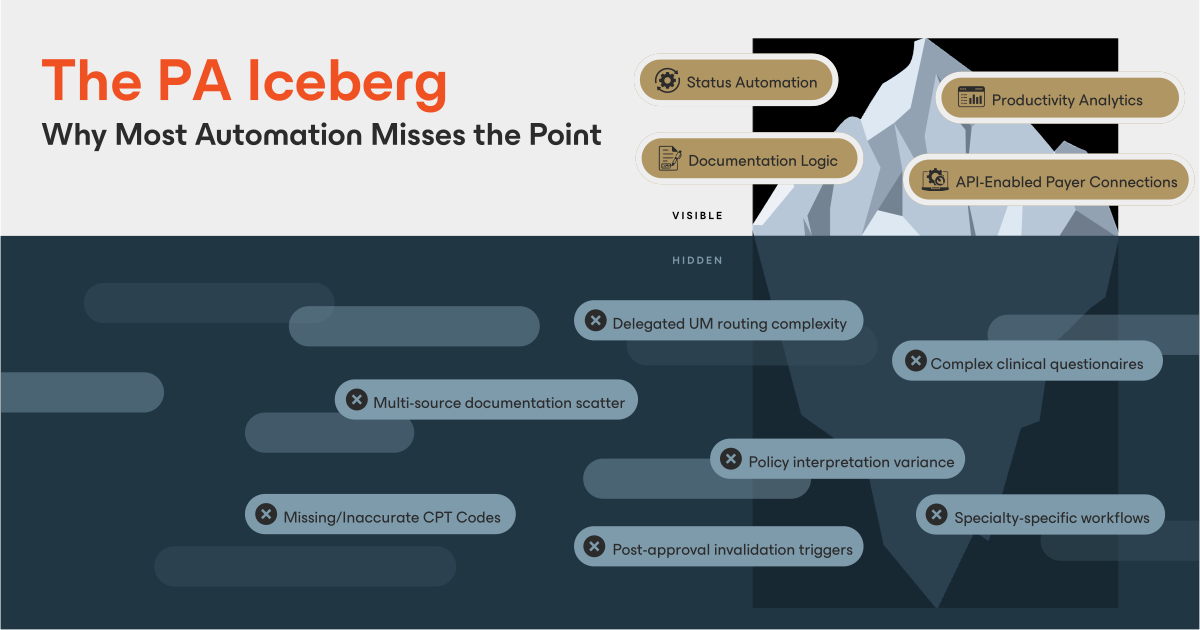
"BlueCross BlueShield" isn't one integration— it's dozens of delegated UM vendors, regional processing centers, and benefit-specific pathways. A prior auth for the same CPT code might route to Availity for one patient, eviCore for another, and Carelon for a third, depending on plan type, state, and service category. Some accept real-time API submissions; others require eFax to specific numbers that change without notice; some use proprietary portals with mandatory fields that don't map to standard data elements. Your automation either handles this invisibly or dumps it back on your staff to figure out case by case.
An infusion authorization has almost nothing in common with a radiology authorization. Infusion requires drug policy deconstruction, benefit determination intelligence (medical vs. pharmacy), attestation automation, and coordination across referral, pharmacy, and infusion teams. Radiology needs rapid turnaround for stat cases, imaging protocol validation, and coordination with fixed scheduling windows. Orthopedic surgery authorizations require surgical history, conservative treatment documentation, and functional assessment scores. Automation that treats all prior auths as interchangeable forms will optimize for none of them.
Payer policies often change frequently and are written in language that resists automation. A medical necessity policy might reference "recent imaging," "failed conservative therapy," or "appropriate diagnosis codes" without defining recent, failed, or appropriate. One payer requires wound measurements in centimeters; another accepts only surface area calculations. Step therapy rules reference drug hierarchies that shift with formulary updates you won't find published anywhere. Then layer on CMS regulatory changes, state-level mandates, and payer-specific interpretations of federal rules.
The difference between 90% touchless and 60% touchless often comes down to whether your system can interpret these nuances or simply flags them for human review.
For a single lumbar fusion authorization, you might need: the ordering physician's note, imaging reports from three different dates, physical therapy records, pain management history, a previous surgery operative report, and current medication lists. These documents exist across different EHR modules, outside facilities, and sometimes scanned PDFs in document management systems. Just collecting the documents isn't enough. You need to extract the specific clinical elements payers actually evaluate and answer attestation questions with cited evidence. Generic automation bundles whatever's accessible and hopes it's sufficient. Purpose-built automation understands which document types matter for which procedures, where to find them, how to extract relevant clinical details, and how to align evidence to policy requirements.
Getting the authorization is only half the battle. A CPT code change, a date shift, a site-of-service modification, or a scheduling conflict can invalidate an approval without anyone noticing until the claim is denied. By then, the procedure is complete, the patient has been treated, and you're facing revenue loss. Most PA automation stops at submission and status tracking. It doesn't monitor for the changes that trigger post-approval invalidation, doesn't pull cases back into workflow when authorizations become invalid, and doesn't alert teams in time to prevent reschedules or revenue loss.
The prior authorization iceberg isn't new. What's new is that healthcare organizations can no longer afford to ignore what's beneath the surface. When your authorization volume is growing, your staff capacity is shrinking, and your margin pressure is intensifying, the difference between surface-level automation and depth-solving automation becomes existential.
Surface-level tools might eliminate some data entry. They might speed up status checking. But they don't prevent the reschedules, the peer-to-peer calls, the denials, or the revenue write-offs that actually hurt your operation. They don't create the capacity your team needs to scale. And they don't deliver the outcomes you were promised in the demo.
Prior authorization is the constraint that determines the pace of everything downstream— scheduling, staffing, revenue capture, and ultimately, patient access to care. When PA stays stuck, everything else waits.
Understanding why automation underdelivers is the first step. The next is recognizing how PA's hidden complexity creates cascading delays across your entire revenue cycle—and why solving PA unlocks more than just authorization efficiency. Learn more: https://www.humatahealth.com/resources/the-pa-hourglass-why-everything-else-waits-on-prior-auth

Centralized vs. Decentralized Prior Auth, Compared
Prior Authorization
Provider

Prior Authorization Regulations by State: A 2026 Guide
Policy
Prior Authorization
Provider

Efficiency Unlocked: How URMC Transformed Prior Authorization with Humata’s AI Technology
Provider
Prior Authorization
Technology


