All posts




All posts
Provider
Prior Authorization
Technology
July 20, 2026
Physicians completed an average of 40 prior authorization requests per week in late 2025, according to the American Medical Association's most recent physician survey, a volume that consumed roughly 13 hours of physician and staff time that could have gone toward patient care. Nearly a third of physicians said their requests were often or always denied, and 88% reported that prior authorization increases overall health care resource utilization, which is a remarkable admission for a process whose entire justification is cost control.
That distance between what prior authorization is supposed to accomplish and what it actually produces is where its real cost lives, distributed quietly across write-offs, rescheduled procedures, peer-to-peer reviews that pull clinicians away from patients, and staff capacity absorbed by rework that a cleaner process would never have required. Most health systems generate some version of this data through their existing prior authorization workflow, which raises a more useful question than whether the data exists: whether anyone is using it to change what happens next.
Most prior authorization solutions produce reporting of some kind, tracking case volumes, approval rates, and turnaround times well enough to confirm that a problem exists without explaining where it originates or how to improve processes. Genuine operational intelligence focuses on a different level of resolution, disaggregating performance by payer, by service line, by procedure, and by provider. Denial rates are rarely uniform across an organization and the reasons behind them vary just as widely. A payer that erroneously denies well-documented submissions calls for a different intervention than a service line where the documentation itself is falling short, and treating the two as the same problem tends to waste whatever improvement effort is applied.
The financial consequences of this lack of granularity compound in ways that are easy to underestimate. Scheduling teams working without payer-specific days-to-decision data build schedules on assumption rather than evidence, which is precisely what produces the downstream reschedules that erode both revenue and the patient experience. Moreover, leadership without visibility into peer-to-peer rates has no reliable way to identify which documentation gaps are driving those escalations in the first place. The data sits inside the workflow. What determines its value is whether it surfaces in an actionable way.
A best-in-class prior authorization analytics suite separates performance data into two distinct tiers, each built to answer a different question and each necessary to the other. Technology performance analytics measure how effectively the automation itself is functioning, tracking whether cases are auto-closing at expected rates and surface exactly where manual touches remain necessary in a workflow that was designed to minimize them. This tier serves as the health check on the technology, and it is the layer most vendors are comfortable showing.
Clinical and operational insight analytics operate at a level deeper, identifying what is or isn't driving first-pass approval including completeness and accuracy of supporting documentation bundling quality, provider-level documentation habits, and payer-specific denial patterns and turnaround times. This is the tier that answers where the process is actually breaking down and what needs to change to fix it, and it tends to be far thinner in most vendor offerings than the reporting layer that gets demoed first.
Run together, these two tiers stop functioning as a reporting exercise and start functioning as a continuous improvement engine, one that surfaces patterns across payers, providers, service lines, and procedures early enough for a team to intervene rather than discovering them months later in a write-off report.
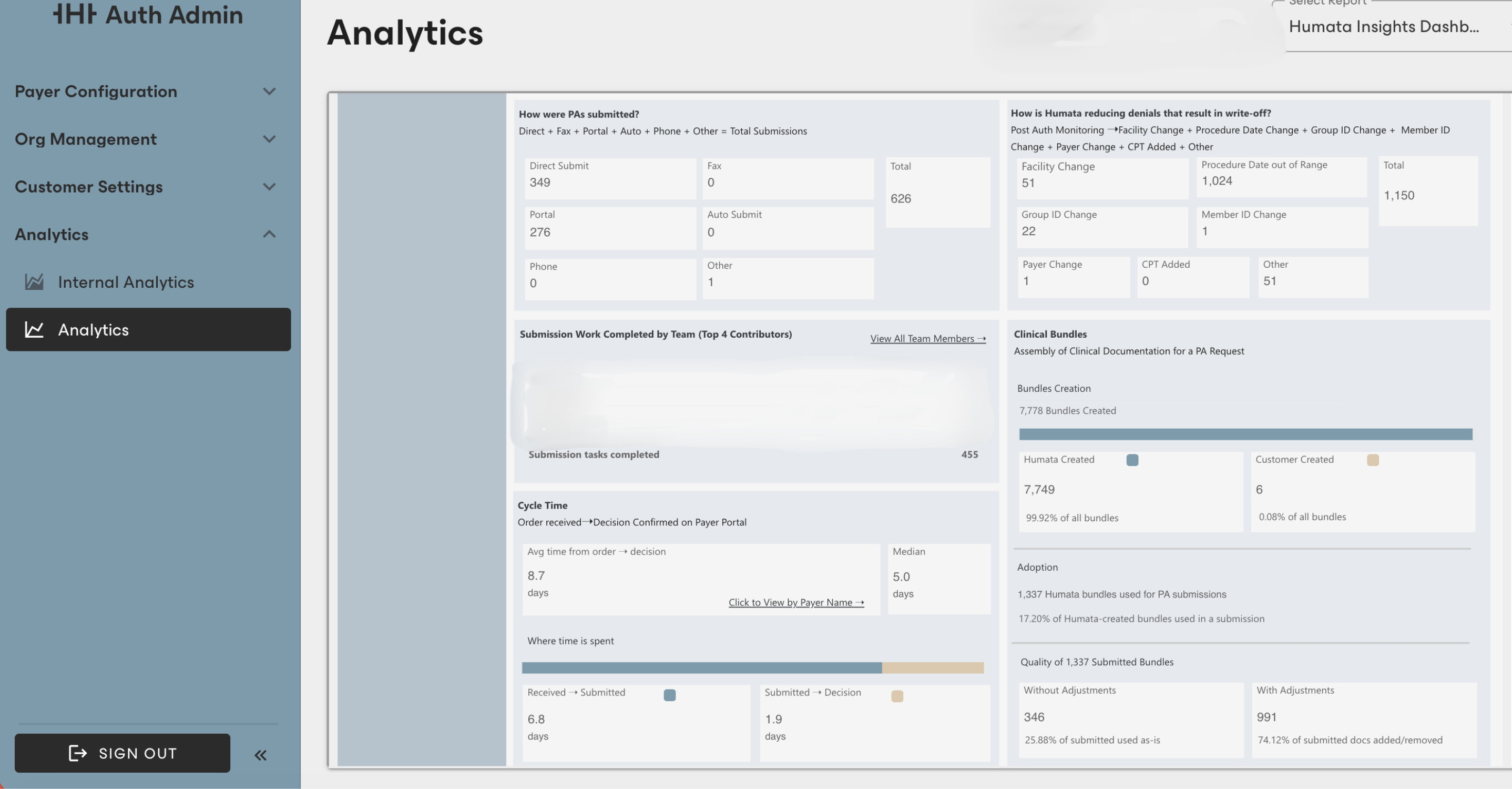
The financial case for mature analytics result in capacity savings from reduced manual rework, write-off reduction from catching problems before they reach a denied claim, fewer peer-to-peer reviews as documentation quality improves, and protected top-line revenue as approved authorizations hold through to the claim.
Humata Health customers operating with this analytics model see it reflected in first-pass approval rates of 96%, write-off reductions between 30% and 45%, and an 83% drop in reschedules tied to authorization issues, and none of those figures trace back to a single fix. They accumulate because the system identifies the next friction point, whether that is a payer pattern, a provider’s documentation habits, or a scheduling assumption nobody had questioned, and uses that insight to remove root-cause issues.
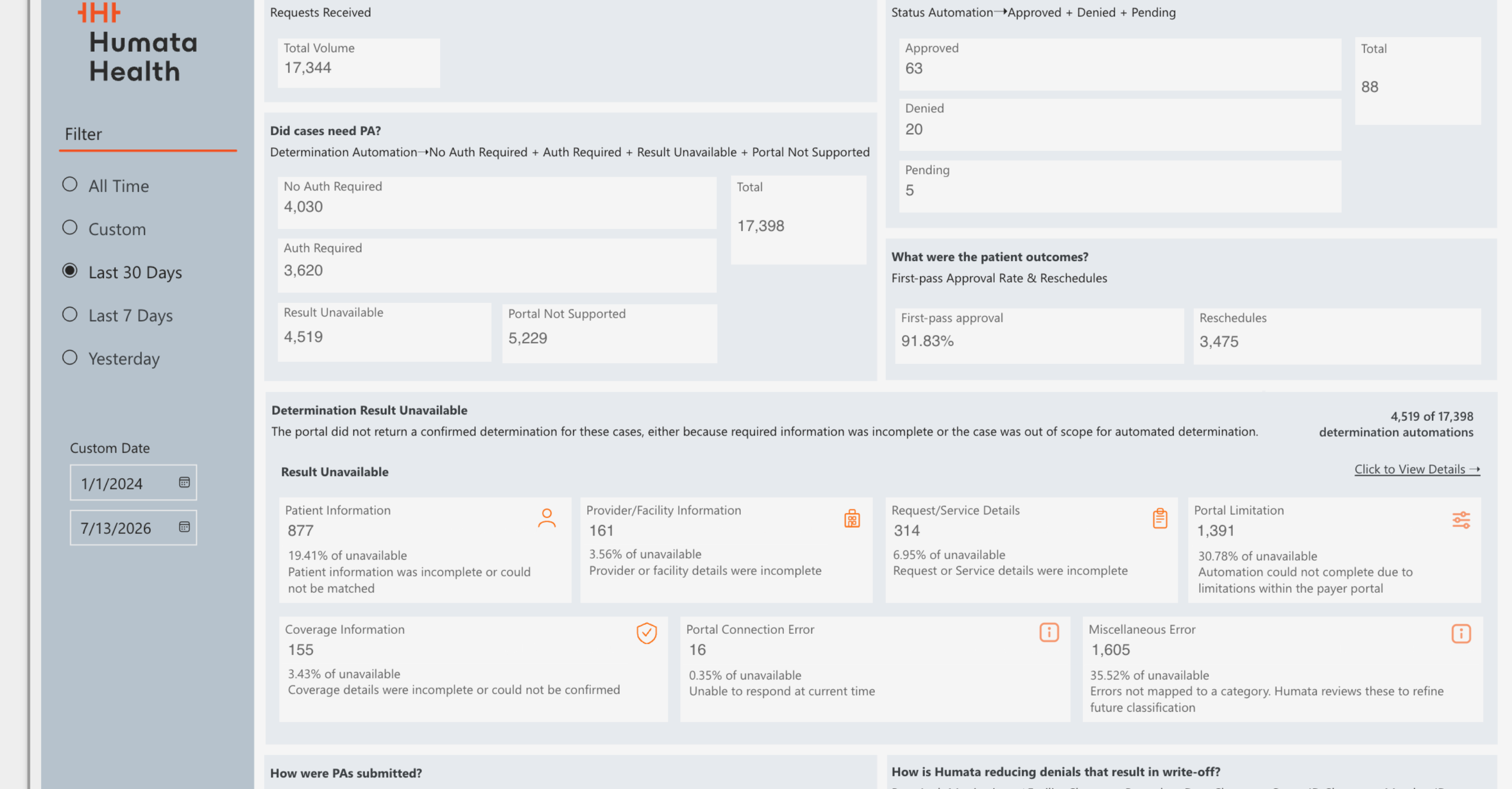
Organizations getting the most value out of prior authorization technology tend to treat analytics as part of their infrastructure rather than a reporting add-on, which shows up in the questions they bring to a vendor evaluation: whether denial and approval data can be broken down by payer, service line, and provider; whether the platform can surface days-to-decision by payer and CPT code with enough lead time to inform scheduling; whether dashboards export cleanly into broader financial reporting. The answers to those questions determine whether analytics remains a static dashboard reviewed once a quarter or becomes the mechanism that keeps performance improving every quarter after that.
Prior authorization is not going to get simpler on its own, regardless of how many pledges insurers sign. The organizations building continuous improvement into their prior authorization analytics now are the ones positioned to keep converting that complexity into savings, rather than spending another year simply measuring what it costs them.
To learn more, contact us here.

Prior Authorization is Stalling Your Revenue Cycle
Prior Authorization
Provider
We’re Bringing Our Prior Authorization Tech to the Independent Practices That Need It
Prior Authorization
Provider
Technology

A Health System's Checklist for WISeR Readiness
Prior Authorization
Technology
Policy