All posts


All posts
Policy
Prior Authorization
Provider
Technology
November 12, 2026
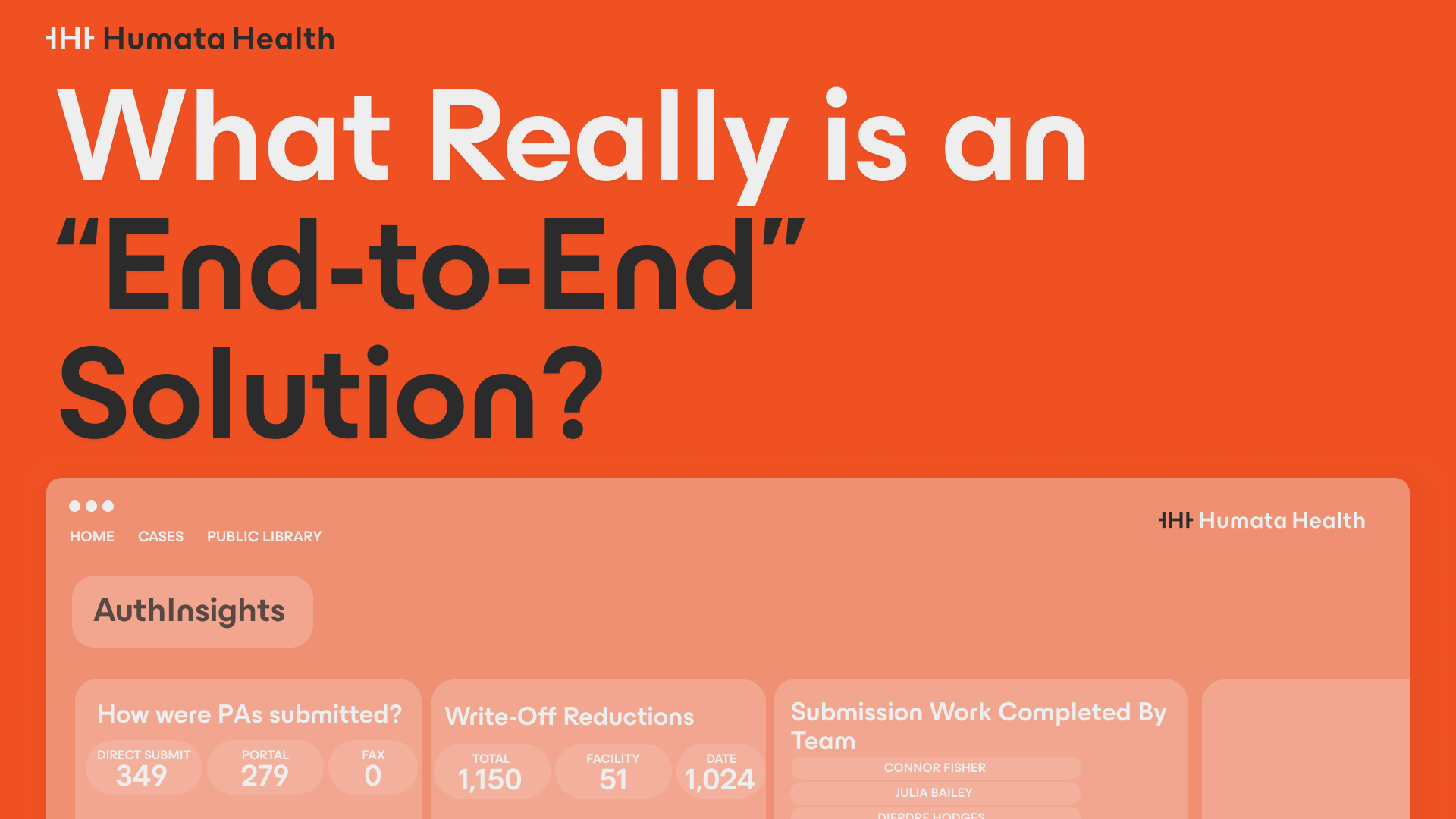
End-to-end prior authorization is a single, continuous workflow that carries every authorization from the first requirements check through submission, statusing, and post-submission monitoring until the order is seen through, with every case visible and accounted for. The clearest way to test it is to look for the hand-offs, meaning the points where a case drops out of that workflow and onto someone’s to-do list or a separate portal. An end-to-end solution is one where cases stay inside the workflow from start to finish, with full visibility and minimal staff burden.
A prior authorization doesn’t start with building a submission package. Every authorization starts with a question that sounds simple and frequently is actually a time-consuming goose chase: does this service, for this patient, under this plan, require prior authorization at all? The answer depends on the procedure and diagnosis codes, the specific plan, and the site of service, and in many cases on a delegated review entity whose rules differ from the health plan's own.
An end-to-end solution does these checks for the staff, resolving requirements automatically as the order or referral is created. At this first end point, a true end-to-end solution goes directly to the payer for the answer with existing connections, since internal rules tables can fall out of date as payer policies change rapidly and without notification. Cases that need no authorization are documented, cleared, and monitored for changes, and the ones that do move forward into case preparation.
Submitting an authorization that gets approved the first time depends on whether the clinical documentation matches what each specific payer requires, and most denials can be attributed to missing or misaligned documentation. Preventing them has historically meant staff tracking down the payer's current policy and then combing the patient’s medical record for the clinicals that meet requirements, often finishing with an attestation questionnaire answered one field at a time, also from the chart.
End-to-end automation absorbs the manual searching for payer criteria and documentation. Payer-specific policy criteria are retrieved and applied automatically while NLP-driven document classification assembles a documentation bundle directly from the patients chart. Attestation questions are auto-filled with evidence pulled directly from the chart, so every response traces back to its source, and documentation gaps surface before submission. When a case does need a reviewer, the evidence behind each payer criterion is already mapped and in front of them. Humata customers have seen clinical bundling run 80% faster and first-pass approval rates reach 96%, which is what this stage looks like when it is fully automated.
A complete case still has to reach the payer, and payer connectivity is where many automation claims quietly narrow. Fully electronic transactions accounted for just 40% of medical prior authorizations in the 2025 CAQH Index, which means most authorizations still move through payer portals or manual channels like fax and phone. CMS-0057-F will raise that share by requiring Medicare Advantage, Medicaid, CHIP, and federal exchange plans to offer FHIR-based Prior Authorization APIs by January 1, 2027. Commercial plans outside the mandate aren’t covered, though, and payers will adopt at different paces. A solution that automates only the electronic share of that traffic leaves staff handling the rest by hand, and the rest is the majority.
End-to-end submission covers every pathway a payer actually uses. Humata connects to 250+ payers through direct API connections along with eFax and portal-based submission, reaching national and regional plans as well as the delegated entities that review on their behalf. As FHIR APIs come online, they become one more pathway, so the channel a payer requires no longer decides whether a case is automated.
The most common hand-off in an "end-to-end" workflow appears right after submission. Someone has to seek out what the payer decided, if they have decided yet, record that decision in the patient's chart along with the authorization details scheduling and billing will rely on later, from the authorization number to the approved date range. When this job falls back to staff checking portals and relaying details into the EHR, the case has left the automated workflow, and every repeated field becomes an opportunity for an error that surfaces weeks later as a denial.
An end-to-end solution retrieves status automatically across payers and writes each outcome back to the EHR bi-directionally, so the patient record reflects the decision without anyone having to carry it there by hand.
Approval feels like the finish line, and for most of the industry's history it has been treated as one. An approved authorization can still be invalidated before the service is billed, whether a CPT code is updated once the procedure is documented, the date of service moves, the site shifts, or the patient's coverage changes, and a claim filed against the original approval is denied for care the health system already delivered. With physicians and their staff already spending an average of 13 hours a week on prior authorization, few teams have the capacity to recheck every approved case by hand before it reaches billing.
That makes the claim the true second end of an end-to-end workflow. Post-authorization monitoring watches approved cases continuously for the changes that would invalidate them, then flags and pulls affected cases back while the authorization window is still open. Health systems using Humata have reduced write-offs by 30–45%, which is where complete coverage of the workflow shows up on the balance sheet.
Covering every stage is half of the definition. The other half is whether those stages run as one continuous workflow, which depends on where the solution lives and how much of the organization's authorization volume it can carry.
A solution embedded natively in the EHR keeps authorization work inside the system where work is actively being completed and documented, so staff don’t need a separate application to work a case and nothing has to be rewritten and documented between two systems. Scope matters just as much. Authorization volume spans every specialty, from imaging and surgery to oncology drugs and infusions billed under either the medical or pharmacy benefit. When some of those service lines run through separate tools, or secondary and tertiary coverage drops back to manual handling, an organization ends up maintaining several partial workflows, each with seams of its own.
When those pieces hold together, routine cases move through with little manual handoffs, and the cases that need human attention arrive with the work already done, the documentation assembled and the payer's criteria mapped against it. Authorization teams spend their time where their expertise changes the outcome, on complex clinical scenarios and escalated payer reviews, with every authorization in the organization visible from order to outcome. For the people doing the work, that is the practical meaning of end-to-end.
End-to-end becomes a useful term once it has edges. When both ends are named and every handoff between them is accounted for, it turns into something a health system can measure and a vendor can be held to, which is exactly what an evaluation of this weight deserves.
For a complete framework to evaluate prior authorization solutions across every stage of the workflow, including a checklist you can apply to any vendor, download our Buyer's Guide to Evaluating Prior Authorization Solutions.


Illinois: Sweeping Reform That Changed the Conversation
Policy
Prior Authorization
Provider

2026 Prior Authorization Regulations: What to Know
Prior Authorization
Policy

Why Prior Authorization Is Broken: A Full History
Prior Authorization